Bobolinks and Community Markets

A little over two years ago, the University of Rhode Island and EAM began a project to experiment with a community-based market supporting bobolink habitat preservation on farm fields in southern Rhode Island. Our goals were both farmland conservation and economic analysis to determine more precisely willingness-to-pay for farm management practices that improve wildlife habitat.

Initial results have been encouraging, we’ve been able to protect several fields over the first two years (I’ll have more to say about the economic analysis as the Summer progresses, but intially we’ve found about 10% of the community willing to participate).

I start with this post because we’ve gotten significant press on the project and yesterday I became aware of a group in Minnesota who had implemented an exchange.

http://www.stillwatergazette.com/articles/2008/06/09/news/news510.txt

Here is the Audubon Magazine article on the project….more information to come as we analyze economic data…
Audubon Magazine Article 

Senate Climate Bill

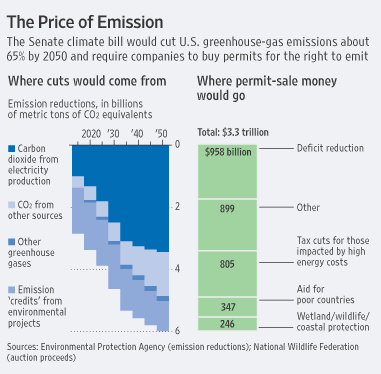
Economic Overview of the Senate Climate Bill

It appears that the Climate Bill is dead until next year….above is an interesting overview of the economic picture they were proposing. Here’s the short version of the vote:

Senate Republicans on Friday blocked a global warming bill that would have required major reductions in greenhouse gases, pushing debate over the world’s biggest environmental concern to next year for a new Congress and president.

Democratic leaders fell a dozen votes short of getting the 60 needed to end a Republican filibuster on the measure and bring the bill up for a vote, prompting Majority Leader Harry Reid to pull the legislation from consideration.

The Senate debate focused on bitter disagreement over the expected economic costs of putting a price on carbon dioxide, the leading greenhouse gas that comes from burning fossil fuels. Opponents said it would lead to higher energy costs.

The 48-36 vote fell short of a majority, but Democrats produced letters from six senators — including both presidential candidates Barack Obama and John McCain — saying they would have voted for the measure had they been there. 

Carbon Trading Doesn’t Work…WIRED Magazine

A recent issues by WIRED magazine tickled my concerns for carbon markets…and the ‘global generalization’ they represent. The article points out some of the fundamental problems with the Kyoto Protocol…and the huge issues of certification and monitoring.

But where the article gets REALLY interesting is in the last paragraph….”Nationally managed emission-trading schemes could do a better job than Kyoto’s we-are-the-world approach by adding legal enforcement and serious oversight. But many economists favor a simpler way: a tax on fossil fuels. A carbon tax would eliminate three classes of parasites that have evolved to fill niches created by the global climate protocol: cynical marketers intent on greenwashing, blinkered bureaucrats shoveling indulgences to powerful incumbents, and deal-happy Wall Streeters looking for a shiny new billion-dollar trading toy. Back to the drawing board, please.”

OUCH!…at least they say markets are better mechanisms for change than command and control.

I admit being in meetings where the “Wall Streeters” remind me of the local subdivision developer who wants to pay $200k for a property and make $2M in a couple of years…while doing little work and ruining the natural assets of the property.

The 2007 Farm Bill…well almost…and Ecosystem Services

The Farm Bill has finally been passed, vetoed, and veto-overridden. It’s a law!…or at least all of it except for that little 30 page clerical error.

So what does it say about ecosystem service markets?  Here’s the news from USDA:

The farm bill governs federal farm, food, and conservation policy and is renewed every five years. The last farm bill, the Farm Security and Rural Investment Act of 2002, underwent a series of extensions while Congress debated a new bill. On May 22, 2008, Congress overrode the President’s veto on 2007 farm bill legislation, enacting the Food, Conservation, and Energy Act of 2008 (PDF, 1.4 MB) into law. The new farm bill was assembled to include fifteen titles: commodity programs, conservation, trade, nutrition, credit, rural development, research, forestry, energy, horticulture and organic agriculture, livestock, crop insurance and disaster assistance, commodity futures, and miscellaneous provisions, and trade and tax provisions. However, the trade title was omitted from the farm bill legislative package due to a clerical error – Congress will respond to this error over the coming weeks.

The new Farm Bill takes a first step towards facilitating landowner participation in emerging markets for ecosystem services. Section 2709 of the conservation title requires USDA, in consultation with other agencies and interests, to “establish technical guidelines that measure the environmental services benefits from conservation and land management activities.” These guidelines will be used in the development of measurement and reporting protocols and registries. Section 2709 also calls for a verification process and guidelines for reported conservation and land management activities.