Blog Feed

Syria, Drought, Agriculture, and Social Distress

Syria faced a devastating drought between 2006 and 2010, affecting its most fertile lands. The four years of drought turned almost 60 percent of the nation into a desert. It was a huge amount of land that could not support cattle trading and herding, Chanda says, killing about 80 percent of cattle by 2009.

The water shortage and drought drove up unemployment, in agriculture. So hundreds of thousands of farmers, Chanda says, went to where they might find work: the cities. He says they were met “almost callously” by the Syrian government.

“People felt that they were being discriminated against and not being helped, perhaps because of the sect they belong to,” Chanda says. “I think this dislocation and the dire condition created the … first spark in Dara’a.”

On top of that, the government began awarding the right to drill wells for water on a sectarian basis. So when the rains dried up, desperate people began digging illegal wells, which also became a political act.

The NPR Report

Chinese Chicken, Food Safety, and USDA

Here’s a bit of news that might make you drop that chicken nugget midbite.

Just before the start of the long holiday weekend last Friday, the U.S. Department of Agriculture quietly announced that it was ending a ban on processed chicken imports from China. The kicker: These products can now be sold in the U.S. without a country-of-origin label.

For starters, just four Chinese processing plants will be allowed to export cooked chicken products to the U.S., as first reported by Politico. The plants in question passed USDA inspection in March. Initially, these processors will only be allowed to export chicken products made from birds that were raised in the U.S. and Canada. Because of that, the poultry processors won’t be required to have a USDA inspector on site, as The New York Times notes, adding:

“And because the poultry will be processed, it will not require country-of-origin labeling. Nor will consumers eating chicken noodle soup from a can or chicken nuggets in a fast-food restaurant know if the chicken came from Chinese processing plants.”

Earlier in the week I reported on the concerns that small farmers have about the newly proposed FDA food safety regulations. Now I read the USDA allows CHINESE poultry processing plants to convert American or Canadian chickens (chickens raised 2,000 miles from the processor) and to market them WITHOUT country-of-origin labeling. The Chinese processor will also NOT need a poultry processing inspector on site.

Don’t get me wrong…I want all the people of the world to prosper and be healthy…and the Chinese are part of ‘all the people of the world’.

Call me crazy, but combining what I know about the new FDA proposed food safety regulations with what I know about this recent USDA ruling….I think the American political leaders on food and agriculture look like fools.

Again I’m going to go out on a political limb – but it does not appear that these policies are being driven by government decision-making in the public interest.

And there is more:

And, chicken lovers, brace yourselves: There’s more. A report suggests chicken inspections here in the U.S. might be poised to take a turn for the worse. The Government Accountability Office report said this week it has serious “questions about the validity” of the new procedures for inspecting poultry across the country.

Basically, these changes would replace many USDA inspectors on chicken processing lines with employees from the poultry companies themselves. The USDA has been piloting the new procedures, which will save money and significantly speed up processing lines, in 29 chicken plants. As The Washington Post , the plan is to roll out the new procedures eventually to “most of the country’s 239 chicken and 96 turkey plants.”

The problem? According to the GAO, the USDA did a poor job of evaluating the effectiveness of the pilot programs it has in place.

As a result, the report concludes, it’s hard to justify the USDA’s conclusions that the new procedures will do a better job than current approaches at cutting down on the number of dangerous bacteria like salmonella that pop up on the birds that will later end up on our dinner tables.

LOVELY!

Here is the NPR Report

Here is one of the many comments at the NPR Report (I find it too cynical, but the reference to food as ‘protein’ is totally valid commentary on our industrial food industry’s mechanistic view of what nourishes us.)

I think US-Based poultry producers are playing The Long Game here, looking for a quid pro quo from China hoping it will now open its doors to US produced chicken – it’s all about the money – Agra-producers of protein need to push the cheapest possible product out to the largest number of consumers, regardless of the ethical questions of how the animals are raised or slaughtered, regardless of the conditions of the workers who do the processing, and regardless of the safety of product that finds it’s way onto the tables of our families. It’s about a Machine that processes protein worldwide for mass consumption at the lowest possible unit cost. It’s about how Industry’s money subverts the safety process via purchased politicians. It’s going to happen, and there’s nothing you or I or anyone else can do about it.

Here is the USDA Ruling on the Chinese Processors.

And, by the way, I think there ARE things you and I can do about these food ethics issues!
Small Farmers and New Food Safety Rules

Proposed new food safety rules are troubling to small farmers. Driven by some recent (since 2006) food contamination and disease issues, the FDA has proposed new rules for food safety.

This morning, NPR did this report.

One of the comments on NPR’s website reflects my concern:

Small farmers should continue to push back–harder and harder. As the owner of a small independent pharmacy, I deal with regulations that are designed to stop fraud, but do absolutely nothing but increase my paperwork. Just to sell a few blood glucose test strips to Medicare patients, I would have to be “accredited”. That means paying an accrediting agency thousands of dollars AND producing hundreds of pages of handbooks that do nothing. For my five employees (including myself) administrative documentation and mandatory redundant training wastes untold hours.

I fear that food costs could go the way of medical costs: documentation and “CYA” will make it unaffordable.

Although I have not done any research on the past food safety data, it appears from media attention that the most significant problems are from large scale agriculture, and the time delays and transportation involved in large scale food distribution.

That all farmers should exhibit good food safety practices makes complete sense…that the FDA creates an entirely new bureaucratic regulatory framework for common sense food practices at a small scale makes no sense.

My guess is competent research would show that good food safety risk management would show the greatest risks – by far – are with large scale agriculture and food processing.

My second guess is that additional regulatory processes and paperwork would only marginally reduce risks in large scale agriculture and food processing – even if the FDA were going to adequately staff and enforce regulations (which I think is extremely difficult in our current economy).

High Fructose Corn Syrup

From the Citizens for Health blog…

Exactly how much fructose does a can of Coke contain?

If you’ve been reading my blogs here at Food Identity Theft, you’ve no doubt heard about HFCS 90, a ‘super-high’ high fructose corn syrup formulation which, according to a leading manufacturer of this laboratory-created sweetener, Archer Daniels Midland, is the “ideal choice for reduced calorie foods such as beverages, jellies and dressings.”

My previous research indicated that both the U.S. Department of Agriculture and the Food and Drug Administration (FDA) know about HFCS 90 and its food uses. Numerous studies, patents (including a method for using HFCS 90 to produce a reduced-calorie beverage that was assigned to PepsiCo) and journal articles refer to it and all the different foods that can be sweetened with it.

Of course, the position of the Corn Refiners Association (CRA) has been that the fructose content of HFCS is “virtually the same” as real sugar — saying on its web site that the sweetener “is actually NOT high in fructose.”

But now, the CRA itself has come out and admitted that HFCS containing such mega doses of fructose has been in use “with FDA knowledge for decades.”

The Report

Golden Rice…The Food of Politics

golden-rice

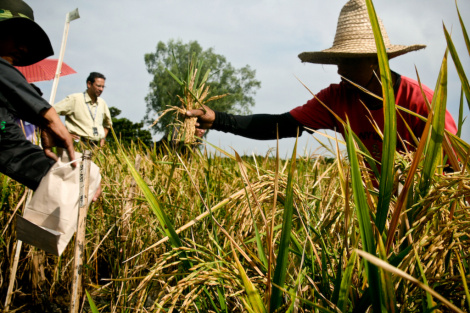
Golden Rice is rice that’s been genetically engineered to deliver enough beta carotene to improve the health of the malnourished poor who might eat it. (Deficiencies blind over 250,000 children a year.) It’s a humanitarian project — funded by the Rockefeller and Gates foundations, among others — that has been in development since the 1990s. Some people object to it; they see it as a Trojan Horse that the biotech industry is using to enter countries that might otherwise reject their technology.

The Grist Article

In my humble opinion, this article’s real value is in pointing out the difficulties when one ‘kind’ of people decide their going to solve vast problems for another ‘kind’ of people….the real fool’s gold is the hubris that underlies many technical solutions.

Antibiotic Use In Livestock…And The Food We Eat

Yesterday I attended the USDA NRCS Technical Team meeting for the State of Rhode Island. As part of the meeting, we reviewed many of the accountability measures that USDA has in place for farmers who utilize their conservation practices programs. In order to utilize conservation practice payments from USDA a farmer needs to document resource concerns and provide a substantial amount of data, testing, and documentation before they qualify (or as part of the practice planning and implementation process).

As I’m driving back to my office, I find myself listening to a NPR report on antibiotic use in industrial livestock operations. As I’m listening I hear the reporter say…

There’s a heated debate over the use of antibiotics in farm animals. Critics say farmers overuse these drugs; farmers say they don’t.

It’s hard to resolve the argument, in part because no one knows exactly how farmers use antibiotics. There’s no reliable data on how much antibiotic use is intended to make animals grow faster, for instance, compared to treating disease.

Given USDA requires all kinds of data and information from small farmers to aid their environmental improvement practices, it seems reasonable that USDA could find a way to follow the use of antibiotics in livestock. The problem is a mindset that some farmers – particularly older farmers – have about their ‘private land’ and its management….very much a ‘don’t tread on me’ philosophy. Given the evolution of CAFO’s (Concentrated Animal Feeding Operations) I think CAFO operators have now made their private land and its management a public health concern.

The NPR Report

Reviving An Heirloom Corn That Packs More Flavor And Nutrition

Corn

Barber says this corn is just one example of what can happen when crops are bred to be flavorful and colorful, not just big.

The chef says he hopes this story becomes more than just a foodie fascination with heirlooms because he thinks there’s more at stake here about the way our food is grown.

“What I’ve come to learn from this experience is that if you are pursuing great flavor,” he says, “you are pursuing great nutrition. It’s one and the same.”

And what he’d like to see is for farmers and plant breeders to work together to combine the best of the old with modern breeding techniques that may help pack more nutrition into the foods we all eat.

The NPR Report

Small Farmers and Environmental Benefits

Many of today’s young farmers (and a good number of older, thoughtful small operators) are committed to farming in a manner that creates minimal environmental harm (I think any human land use, by definition, creates environmental and ecological change to the landscape)…and produces substantial environmental benefits.

Unfortunately, most communities do not provide financial support for these new, small farm environmental benefits. Already in a financially stressed situation, small farmers could realize real improvements in their economy if communities began to 1) value the environmental benefits provided by sustainable small farms, and 2) pay small farmers for the community assets they are creating year after year.

USDA, through its NRCS (Natural Resource Conservation Service), provides incentive payments to farmers. The payments, however, are to address resource concerns…correct an environmental harm or environmental problem (the farmer allows his livestock to pasture in a stream area…NRCS pays for fencing and stream restoration).

With two partner organizations (New Urban Farmers in Pawtucket, RI and the African Alliance Growers Collaborative in Providence, RI) we’ve been working to 1) determine the agro-ecological areas where small farmers are creating environmental benefits, 2) analyze if any of the eco-benefits fit into the structure of USDA NRCS conservation practices and practice payments, 3) if appropriate, expand the payments USDA NRCS is making to small farmers to better align their incentives with the work of small, organic, and urban growers, and 4) examine how other community based agricultural organizations (primarily state conservation districts) might create funds to ‘invest’ in small farm environmental asset building.

From our research, there are six areas where small farmers are creating substantial environmental benefits:

1) Improving the physical, chemical, and biological conditions of soil through compost, mulch, manure, and remineralization practices.

2) Managing nutrients to protect from runoff, improve air quality, and improve production characteristics.

3) Managing weeds and pests with natural methods that improve plant communities/wildlife habitat, enhance the quality of forage, and control pests.

4) Managing water for water control, irrigation, runoff, and water harvesting.

5) Managing farm infrastructure for conservation improvements – tree and shrub establishment, vegetative barriers, etc.

6) Managing farm energy uses to reduce energy use, and improve energy efficiency.

Small farmers are utilizing both novel methods (those developed in the last 30 to 50 years through biodynamic -realizing its’ non-scientific aspects – and permaculture practices utilizing new ecological science) – as well as revisiting old, natural farming processes – to realize their sustainability goals.

These benefits not only increase their farm productivity, they also improve environmental qualities in their communities. They are becoming an increasingly responsible ‘underground’ community of economic asset builders related to those environmental improvements.

Young Farmers Break The Bank…Continued…3% Of Your Wealth

In the last post, I recommended rethinking how your savings, investments, pensions, etc. are being utilized. Most conventional investment mechanisms used by Wall Street do little to diversify wealth and expand social equity (many would say today’s financial markets do quite the opposite – they are, in essence, wealth concentrators). Invest 3% of your wealth in local farmers and food enterprises….and advocate that your community’s institutions, foundations, etc. do the same!

Rhode Island has two major foundations, The Rhode Island Foundation and The Champlin Foundations. Both foundations had above $500 million in assets. I am not familiar with the investment management of The Champlin Foundations.

The Rhode Island Foundation contracts their investment management to a private consulting firm who in turn contracts with other investment advisory firms to manage particular industry/area portfolios. There is no overriding social responsibility criteria to their consultant (I’m certain, I requested it and their only social responsibility actions are to contract with a consultant who advises them how to vote on proxy issues). There is no overriding agro-ecological responsibility criteria.

I have requested a list of their investments and did not receive a reply (although I did receive a long email from their CEO defending their investment behavior).

May I suggest you write to the major private and public foundations and retirement funds in your community/state and ask them 1) if they have social responsibility criteria for their investments, 2) if they have agro-ecological responsibility criteria for their investments, and 3) if they have a list of their investments on a given recent date that they might provide to you.

Please ask them to consider investing 3% of their wealth in sustainable, socially responsible, local farm and food ventures.