Blog Feed

Finance Now Exists For Its Own Exclusive Benefit

This article appears to be a sincere attempt, using Bank of America’s most recent financial statement, to 1) explain the financial mechanisms of current banking, and 2) analyze the risks.

Even with the author’s thoughtfulness, it becomes easily evident that current banking ‘mechanisms’ are based upon a language structure that is, at best, obscure. Reminds me of trying to read Sartre…and that is not a good thing.

The Article

‘Beyond Dangerous’ Climate Change

The consensus in American politics today is that there’s nothing to be gained from talking about climate change. It’s divisive, the electorate has more pressing concerns, and very little can be accomplished anyway. In response to this evolving consensus, lots of folks in the climate hawk coalition (broadly speaking) have counseled a new approach that backgrounds climate change and refocuses the discussion on innovation, energy security, and economic competitiveness.

This cannot work. At least it cannot work if we hope to avoid terrible consequences. Why not? It’s simple: If there is to be any hope of avoiding civilization-threatening climate disruption, the U.S. and other nations must act immediately and aggressively on an unprecedented scale. That means moving to emergency footing. War footing. “Hitler is on the march and our survival is at stake” footing. That simply won’t be possible unless a critical mass of people are on board. It’s not the kind of thing you can sneak in incrementally.

The Article

Cap and Trade Benefits Connecticut

Connecticut’s commitment to the regional cap-and-trade system and subsequent investment in energy efficiency bolsters the economy, even as power plants shell out cash for their air pollution.

In the first three years of the 10-state Regional Greenhouse Gas Initiative, Connecticut’s state government received $51.7 million of the $913.3 million awarded throughout the region. Connecticut invested 73 percent in energy efficiency initiatives; 23 percent in renewable energy projects; 5 percent on offsetting air pollution; and 1 percent on clean energy education for teachers and students.

Because of energy efficiency, the impact on Connecticut’s economy outpaced the average of the 10 states in the regional initiative, according to an economic impact study of the Northeast’s cap-and-trade system, performed by the Boston-based Analysis Group.

The Article

McRib is Back

McDonald’s has renewed the McRib…a concoction actually composed much like sausage then ‘cut’ to shape. It has been much maligned by many.

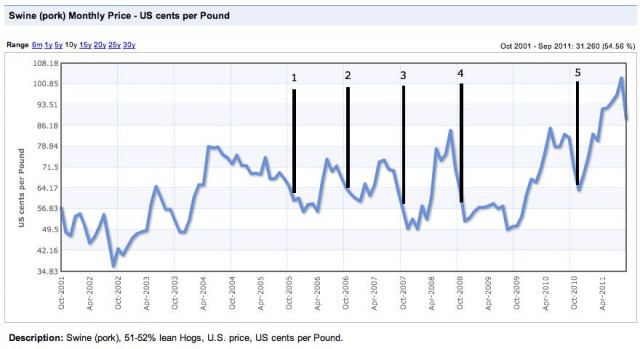
Here is an interesting graph of the periods in which the McRib has been ‘re-introduced’.

Interesting coincidence between pork prices and McRib….their business planners at work.

Tax On Trades

I for one, think this would be a great idea. The micro trades are already a large part of the problem with the stability of the market. A tax might inhibit some of this type of trading (and that’s coming from the son of a specialist broker whose dad worked his whole life on the floor of the NY Stock Exchange)

http://www.dailykos.com/story/2011/11/07/1034109/-Transaction-tax-would-raise-$350-billion-over-next-decade?via=blog_1=