Blog Feed
Sunnyside, New York
I’m in Queens for a couple of days doing some testing at Sloan Kettering (managing prostate cancer).
Sunnyside, New York, USA is amazing. A friend told me 144 languages are spoken in the community. I’m setting in a small restaurant and have not heard a word in English in 20 minutes (except my request for tea!). It is wonderfully interesting, diverse, and…in many ways….kind.
Folks are friendly and considerate, you can buy any ethnic variety of food on the planet (ate at ‘I Love Paraguay’ yesterday…fish soup)….Irish bars on side of Ethiopian, on side of Thai, on side of Moroccan, on side of Italian.
Come see how the world mixes!
Wealth Creation: Part Two
We met on Wednesday with two folks at the Rhode Island Foundation. They are trying to do a good job.
The Foundation is a public trust established many years ago by a local bank which now has around $600 million in assets – 60% are open, 40% are to benefit specific objectives. They appear to be trying to do a good job.
Because we are working on development of a farmland real estate fund in the State, Peter and I have been discussing our planning progress with them – thinking the venture would be of interest to them.
As part of determining how they use money (in order to better know them), I had requested a listing of their investments. I was told they usually do not disclose their investments. They did disclose that they have about $13 million in a number of program related investments (sounds like mainly loans) which evidently they manage themselves.
1) $600 million is substantial.
2) How much of their portfolio is invested in Rhode Island based enterprise?
3) Since it is a Rhode Island public trust, would it not be appropriate that all of their assets be invested in Rhode Island based enterprises?
4) Do they have sustainability and social responsibility criteria for their investment portfolio?
Obviously, they hire professional investment managers to reduce their exposure to risk while providing the best possible return. Those managers are taking a ‘whole earth’ look at the investment universe. They state that they are trying to maximize return in order to have more money each year for grants.
Obviously Number 2, their money management is consistent with most foundations, institutions of higher education, etc.
I bring this up because it is indicative of a broad set of practices that have evolved as a result of contemporary investment banking and the idea of ‘ownership’ -particularly ownership in corporate equities and the enormous number of variations that professional investors (hedge funds, etc.) have cooked up in the last twenty five years. The result is that foundations, NGOs, institutions of higher education, pension funds, and many smaller endowments are now ‘invested’ in these equities, various funds, various bonds and bond funds, etc.
Even if you look at bonds and corporate equities – perhaps the most simple to analyze – the fundamental underlying value is only one of many factors related to the value of ownership…the pschology of the market, outside ratings, etc. drive price…and therefore worth. We now have a relatively abstract ownership culture made up primarily of these kinds of institutional investors, a small group of wealthy individuals, and sovereign wealth funds. Avoiding risks now means ‘hedging’ your ownership.
I suggest a different ownership culture…where ownership is active collaboration with socially meaningful enterprises (developing criteria for ‘social meaningful’ is already going on in a number of circles). The best risk hedge, in my humble opinion, is active involvement and knowledge with enterprise development.
When I think of the total asset value of the Rhode Island Foundation, the Champlin Foundations, the Rhode Island Pension Fund, Brown University and a number of other smaller local endowments, I realize it is very substantial. They invest those monies based upon what they all believe to be the best possible use of funds. From my perspective, that ‘best possible use of funds’ has become too abstact for local needs.
Rhode Island Farmland Values
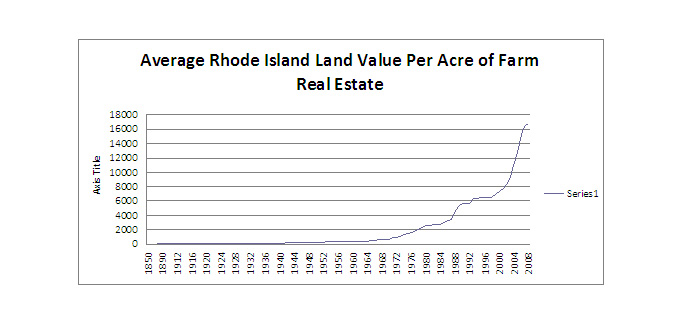 We’ve been doing research on Rhode Island and Maryland farmland values…thought I would share this graph of historical per acre farmland values in Rhode Island.
How Goldman Sachs Created the Food Crisis
A perhaps narrow-minded (a number of reasons for food cost increases), but still informative article on commodity price increases. If you believe what it reports, it is a startling commentary on shortsided human greed. I’m interested to hear any other insights.
The money tells the story. Since the bursting of the tech bubble in 2000, there has been a 50-fold increase in dollars invested in commodity index funds. To put the phenomenon in real terms: In 2003, the commodities futures market still totaled a sleepy $13 billion. But when the global financial crisis sent investors running scared in early 2008, and as dollars, pounds, and euros evaded investor confidence, commodities — including food — seemed like the last, best place for hedge, pension, and sovereign wealth funds to park their cash. “You had people who had no clue what commodities were all about suddenly buying commodities,” an analyst from the United States Department of Agriculture told me. In the first 55 days of 2008, speculators poured $55 billion into commodity markets, and by July, $318 billion was roiling the markets. Food inflation has remained steady since.
Current fracking techniques are not the solution to our energy needs…
http://news.yahoo.com/s/time/20110510/hl_time/08599207053300
Despite the ads to the contrary about cheap American natural gas solving our energy problems …
Keynes vs. Hayek Round Two
For the economic theorists in the crowd….
Measuring Up: Synchronizing Biodiversity Measurement Systems for Markets and Other Incentive Programs
A Report by the Willamette Partnership
I’ve not yet read this…more comments at a later date.
Google Searches
As web companies strive to tailor their services (including news and search results) to our personal tastes, there’s a dangerous unintended consequence: We get trapped in a “filter bubble” and don’t get exposed to information that could challenge or broaden our worldview. Eli Pariser argues powerfully that this will ultimately prove to be bad for us and bad for democracy.
IPCC Special Report on Renewable Energy Sources
IPCC Special Report on Renewable Energy Sources
Although the authors are optimistic about the future of renewable energy, they note that many forms of the technology are still more expensive than fossil fuels, and find that the production of renewable energy will have to increase by as much as 20 times in order to avoid dangerous levels of global warming. Renewables will play a greater role than either nuclear or carbon capture and storage by 2050, the scientists predict.
 Richard Pace