
The Alliance for the Chesapeake Bay “Bay Journal” published the following general article on market efforts in the Chesapeake Bay. It’s an interesting overview, although I could do without also the ‘fashion’ comments…what’s hot and what’s not.
Category: Carbon Markets
Concerns with Carbon Markets
I have ongoing concerns with carbon markets. Alex Steffen, in a recent WIRED article, says it well…
We don’t need a War on Carbon. We need a new prosperity that can be shared by all while still respecting a multitude of ecological limits – not just atmospheric gas concentrations, but topsoil depth, water supplies, toxic chemical concentrations, and the health of ecosystems, including the diversity of life they depend upon.
We can build a future in which technology, design, smart incentives, and wise policies make it possible to deliver a high quality of life at lower ecological cost. But that brighter, greener future is attainable only if we embrace the problems we face in all their complexity.
I’ve been encouraged by the growth of the carbon market…and the potential of those markets to remediate greenhouse gases. But I also realize from our own research and development that we are better off to solve our environmental problems in an integrated and adaptive manner…not being too ‘simple’ in markets designed to solve complex problems. Both in scale and extent, we had tended to be overly general. It has also been difficult to bring capital to complex solutions because, by their sheer complexity, they hold significant risk.
Regional Greenhouse Gas Initiative and Forest Offsets
The Manomet Center for Conservation Sciences has created recommendations for forest offsets for RGGI.
They are very interesting! Think “scale’ as a major factor. From their Introduction:
The Regional Greenhouse Gas Initiative (RGGI) is a cap-and-trade system designed to limit the emissions of greenhouse gases (GHGs) from electricity generation in 10 northeastern states starting in 2009. Power plants seeking to meet their RGGI obligations have the option to offset a portion of their emissions (up to 3.3%) through projects that reduce emissions or sequester carbon in other sectors (such as the forestry sector).The Maine Forest Service and its partners, Environment Northeast (ENE), Manomet Center for Conservation Sciences, and the Maine Department of Environmental Protection, have been asked by the RGGI Staff Working Group to propose recommendations for possibly expanding forest carbon offset project types in RGGI. This document represents a brief summary of our recommendations at this time. As we have worked to develop these recommendations, it became apparent to us that projects under a cap-and-trade program cannot address all that is needed to capitalize on the full potential forests have to reduce atmospheric GHGs; therefore, we recommend a two-pronged strategy which goes beyond these recommendations for expanding the range of carbon offset projects which are eligible. The second prong is to support programs which help keep forests as forests and maintain current management because these efforts too benefit carbon storage even though they cannot meet RGGIs requirements for offsets.
Copenhagen Consensus Report
Over two years, more than 50 economists have worked to find the best solutions to ten of the world’s biggest challenges. During the last week of May, an expert panel of 8 top-economists, including 5 Nobel Laureates, sat down to assess the research.
2008 Global Katoomba Meeting
I just returned this morning from the 2008 Global Katoomba Meeting themed “Developing an Infrastructure Fund for the Planet”….felt a bit like Pat Coady who said to me after the meeting “I have enough trouble trying to save 10 acres in our local land trust and now they want us to save the planet”.
It was a vast and daunting amount of information and opinion. John Holdren of the Woods Hole Research Center opened the meeting with an overview of the current science and economics. He’s a wonderful data presenter…and the news was bleak (I’ll put up his presentation when it becomes available). There were numerous insights both from his science and from other comments though the two days. For example, there are respected scientific analyst who see Lake Meade drying up before two decades….ironically I glance at the Soutwest Airline magazine on the flight to Providence and notice three enormous casino/resort development projects going up in Las Vegas…where have they been getting their environmental and economic advice?
Many of the significant early developers of carbon finance were present, and their thoughts were interesting…although the scale of the financing is troublingly large given the newness of the methodologies for credit creation, verification, and monitoring.
I spent a good bit of time collecting information on new efforts, pilots, and tool development….and tried to push folks along to provide more finance for those efforts.
As the presentations from the conference become available I’ll have more to say.
Senate Climate Bill
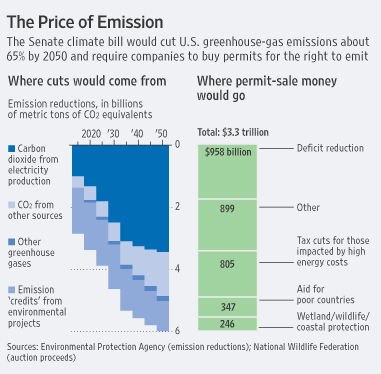
It appears that the Climate Bill is dead until next year….above is an interesting overview of the economic picture they were proposing. Here’s the short version of the vote:
Senate Republicans on Friday blocked a global warming bill that would have required major reductions in greenhouse gases, pushing debate over the world’s biggest environmental concern to next year for a new Congress and president.
Democratic leaders fell a dozen votes short of getting the 60 needed to end a Republican filibuster on the measure and bring the bill up for a vote, prompting Majority Leader Harry Reid to pull the legislation from consideration.
The Senate debate focused on bitter disagreement over the expected economic costs of putting a price on carbon dioxide, the leading greenhouse gas that comes from burning fossil fuels. Opponents said it would lead to higher energy costs.
The 48-36 vote fell short of a majority, but Democrats produced letters from six senators — including both presidential candidates Barack Obama and John McCain — saying they would have voted for the measure had they been there.
Carbon Trading Doesn’t Work…WIRED Magazine
A recent issues by WIRED magazine tickled my concerns for carbon markets…and the ‘global generalization’ they represent. The article points out some of the fundamental problems with the Kyoto Protocol…and the huge issues of certification and monitoring.
But where the article gets REALLY interesting is in the last paragraph….”Nationally managed emission-trading schemes could do a better job than Kyoto’s we-are-the-world approach by adding legal enforcement and serious oversight. But many economists favor a simpler way: a tax on fossil fuels. A carbon tax would eliminate three classes of parasites that have evolved to fill niches created by the global climate protocol: cynical marketers intent on greenwashing, blinkered bureaucrats shoveling indulgences to powerful incumbents, and deal-happy Wall Streeters looking for a shiny new billion-dollar trading toy. Back to the drawing board, please.”
OUCH!…at least they say markets are better mechanisms for change than command and control.
I admit being in meetings where the “Wall Streeters” remind me of the local subdivision developer who wants to pay $200k for a property and make $2M in a couple of years…while doing little work and ruining the natural assets of the property.
 Richard Pace