interactive National Geographic piece ~interactive maps and tables
Category: Climate Change
European Energy Markets
ON JUNE 16th something very peculiar happened in Germany’s electricity market. The wholesale price of electricity fell to minus €100 per megawatt hour (MWh). That is, generating companies were having to pay the managers of the grid to take their electricity. It was a bright, breezy Sunday. Demand was low. Between 2pm and 3pm, solar and wind generators produced 28.9 gigawatts (GW) of power, more than half the total. The grid at that time could not cope with more than 45GW without becoming unstable. At the peak, total generation was over 51GW; so prices went negative to encourage cutbacks and protect the grid from overloading.
The trouble is that power plants using nuclear fuel or brown coal are designed to run full blast and cannot easily reduce production, whereas the extra energy from solar and wind power is free. So the burden of adjustment fell on gas-fired and hard-coal power plants, whose output plummeted to only about 10% of capacity.
These events were a microcosm of the changes affecting all places where renewable sources of energy are becoming more important—Europe as a whole and Germany in particular. To environmentalists these changes are a story of triumph. Renewable, low-carbon energy accounts for an ever-greater share of production. It is helping push wholesale electricity prices down, and could one day lead to big reductions in greenhouse-gas emissions. For established utilities, though, this is a disaster. Their gas plants are being shouldered aside by renewable-energy sources. They are losing money on electricity generation. They worry that the growth of solar and wind power is destabilising the grid, and may lead to blackouts or brownouts. And they point out that you cannot run a normal business, in which customers pay for services according to how much they consume, if prices go negative. In short, they argue, the growth of renewable energy is undermining established utilities and replacing them with something less reliable and much more expensive.
The Economist Article
How Big is the problem of climate change ?
Some things are so big you don’t see them, or you don’t want to think about them, or you almost can’t think about them. Climate change is one of those things. It’s impossible to see the whole, because it’s everything. It’s not just a seven-story-tall black wave about to engulf your town, it’s a complete system thrashing out of control, so that it threatens to become too hot, too cold, too dry, too wet, too wild, too destructive, too erratic for many plants and animals that depend on reliable annual cycles. It affects the entire surface of the Earth and every living thing, from the highest peaks to the depths of the oceans, from one pole to the other, from the tropics to the tundra, likely for millennia — and it’s not just coming like that wave, it’s already here.
http://www.tomdispatch.com/post/175756/tomgram%3A_rebecca_solnit%2C_the_age_of_inhuman_scale/
Syria, Drought, Agriculture, and Social Distress
Syria faced a devastating drought between 2006 and 2010, affecting its most fertile lands. The four years of drought turned almost 60 percent of the nation into a desert. It was a huge amount of land that could not support cattle trading and herding, Chanda says, killing about 80 percent of cattle by 2009.
The water shortage and drought drove up unemployment, in agriculture. So hundreds of thousands of farmers, Chanda says, went to where they might find work: the cities. He says they were met “almost callously” by the Syrian government.
“People felt that they were being discriminated against and not being helped, perhaps because of the sect they belong to,” Chanda says. “I think this dislocation and the dire condition created the … first spark in Dara’a.”
On top of that, the government began awarding the right to drill wells for water on a sectarian basis. So when the rains dried up, desperate people began digging illegal wells, which also became a political act.
The NPR Report
Climate Change
I continue to publish blogs and articles on climate change because the scientific projections are personally frightening…my grandchildren will experience a much changed climate.
From the recent article:
The scientists also projected the velocity of climate change, defined as the distance per year that species of plants and animals would need to migrate to live in annual temperatures similar to current conditions. Around the world, including much of the United States, species face needing to move toward the poles or higher in the mountains by at least one kilometer per year. Many parts of the world face much larger changes.
Read more at: http://phys.org/news/2013-08-climate-faster-million-years.html#jCp
All the Steel Money Can Buy!
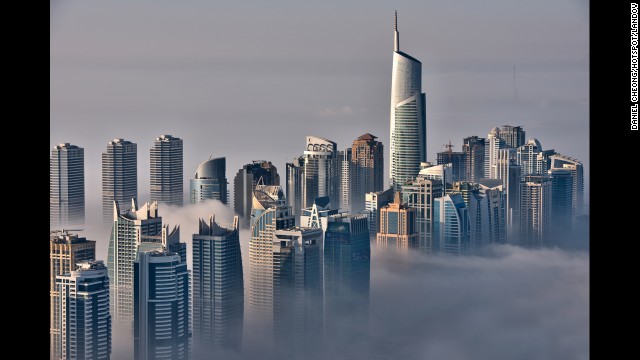
A scene from the latest Brad Pitt zombie film?
Nope, the Dubai skyline along the coast of the Persian Gulf…all the steel money can buy!
Carbon Markets
It appears, just at the moment that President Obama says the word ‘climate change’ for the first time in an eon, the European carbon market has approached collapse.
Some New Weather Concepts
Recognizing “Rivers of moisture” is changing the way California sees flooding and the potential of 100 year floods. “Ten Mississippi Rivers, One Mile High”
Megastorms Could Drown Massive Portions of California- Scientific American
State of the Species
http://www.orionmagazine.org/index.php/articles/article/7146
….very interesting opinion of human species. If you missed it in the recent issue of of Orion Magazine. Its worth a read.
New Musings on a US Carbon Tax
It has been a while since I’ve seen any editorial activity about a carbon tax, but here is an interesting one by David Frum.
 Richard Pace