
A valuable perspective on the politics of climate change
Category: Climate Change
The Cost of Carbon
The peer-reviewed report finds that the true social cost of carbon is in fact more uncertain than the government’s $21 per ton estimate. The entire range of new estimates arrived at in the report, reaching as high as $893 per ton in 2010 and $1,550 in 2050, are all well above the government’s estimate, bringing into question prior analyses of the benefits of reducing emissions.
Comparing prior research on the cost of reducing emissions with the report’s new findings on the social cost of carbon, the report concludes that it is highly likely it is costing us more to do nothing about climate change than it would to adopt mitigation measures.
Corporate Climate Change Action
Franco Fusignani, CEO of New Holland Agriculture and CNH International, commented, “Climate change is the biggest global challenge of our age, and it has particular resonance in the emerging and high potential economies that we serve. Through this sponsorship we aim to contribute to Climate Action’s objective of providing a platform for an ongoing dialogue between business and governments, where international corporations such as ours can highlight solutions they are able to provide for tackling climate change.”
Global Water
A report from Brown Advisory, a Baltimore money management firm, on global water and the business of global water.
Farmland and Flooding
Three professors from Southern Illinois University have written President Obama asking him to leave the Bird’s Point Levee open for wetlands creation. The article is a reaction from the Delta Farm Press. It is a good example of the problems with agricultural and climate change politics.
Debunking the myth that clean energy and carbon reduction policies aren’t good for ratepayers
Two Troubling Issues
In trying to develop our business plan for a Rhode Island Farmland Fund, I’ve been interrupted today by two friends….with news from other friends…that reinforce two of my biggest cultural anxieties. The first is an excerpt from John Phipps whom I consider a voice of reason in the industrial agriculture community. He is speaking about the current debate on the national debt ceiling:
I think many assume there is a script somewhere and the actors are just peaking the dramatic tension. I do not. I think we are being led by badly misinformed, power-motivated politicians who would just as soon push the economy back into recession on the gamble it would be blamed on their opponent.
Because we really don’t know how this failure would play out, there seems to be a curious sense of “Let’s find out!” floating around DC-wannabees. After all, if it goes very badly there will be plenty of mud to be splashed on everyone, and perhaps more of it will stick to the other guy. If you are currently out of power, there could be a “What do we have to lose?” mentality.
The other was an email from Peter Gengler with a link to an article on global warming driven by the thought of Bill McKibben:
McKibben speaks about the need for radical action on carbon emissions.
Carbon Emissions from Energy Use Hit Record Levels
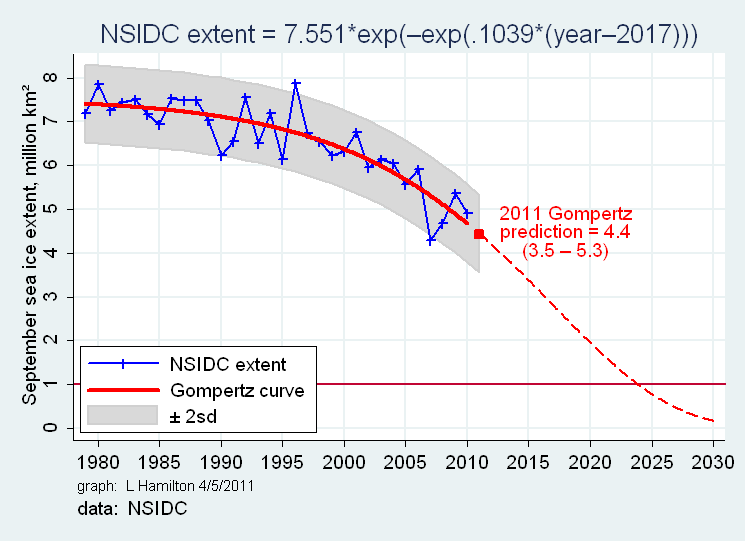
Arctic Sea Ice
Declining Crop Yields
Michael Roberts, a resource economist at North Carolina State University, takes a look at what he calls ‘ a pretty rapid slowdown in productivity growth’.
http://greedgreengrains.blogspot.com/2011/05/declining-crop-yields.html
 Richard Pace