
In April of 2007 the Supreme Court ruled that the EPA had the right to regulate greenhouse gas emissions “if EPA determines they cause or contribute to air pollution that may reasonably be anticipated to endanger public health or welfare.” As you can imagine, this has caused no small amount of handwringing in the current Administration. EPA today issued an Advance Notice of Proposed Rulemaking that begins to deal with the issue (and ‘begin’ is the operative word…). There are some wonderful references to the Clean Air Act by the EPA Secretary and others in their introductory remarks…’antiquated’, ‘outdated’….
Category: Climate Change
The Science and Economics of Sustainability
John Holdren, Director of the Woods Hole Research Center, made this presentation at the Katoomba Meetings earlier this month. ” The Science and Economics of Sustainability: Managing the Competing Uses of Land, Water, and Forests Under a Changing Climate” offers an abundance of sobering information on the state of the global environment and makes suggestions on where and how to act.
Regional Greenhouse Gas Initiative and Forest Offsets
The Manomet Center for Conservation Sciences has created recommendations for forest offsets for RGGI.
They are very interesting! Think “scale’ as a major factor. From their Introduction:
The Regional Greenhouse Gas Initiative (RGGI) is a cap-and-trade system designed to limit the emissions of greenhouse gases (GHGs) from electricity generation in 10 northeastern states starting in 2009. Power plants seeking to meet their RGGI obligations have the option to offset a portion of their emissions (up to 3.3%) through projects that reduce emissions or sequester carbon in other sectors (such as the forestry sector).The Maine Forest Service and its partners, Environment Northeast (ENE), Manomet Center for Conservation Sciences, and the Maine Department of Environmental Protection, have been asked by the RGGI Staff Working Group to propose recommendations for possibly expanding forest carbon offset project types in RGGI. This document represents a brief summary of our recommendations at this time. As we have worked to develop these recommendations, it became apparent to us that projects under a cap-and-trade program cannot address all that is needed to capitalize on the full potential forests have to reduce atmospheric GHGs; therefore, we recommend a two-pronged strategy which goes beyond these recommendations for expanding the range of carbon offset projects which are eligible. The second prong is to support programs which help keep forests as forests and maintain current management because these efforts too benefit carbon storage even though they cannot meet RGGIs requirements for offsets.
New EPA Report Available on Ecosystems and Climate Change
From the US EPA Press Release:
The U.S. Environmental Protection Agency has released a report that can help reduce the potential impact of climate change on estuaries, forests, wetlands, coral reefs, and other sensitive ecosystems. The report, entitled Preliminary Review of Adaptation Options for Climate-Sensitive Ecosystems and Resources, identifies strategies to protect the environment as these changes occur.To develop this assessment, scientists studied national parks, national forests, national wildlife refuges, wild and scenic rivers, national estuaries, and marine protected areas – all protected by the federal government.
The report takes a unique approach by using the management goals set for each protected area to understand what strategies will increase the resilience of each ecosystem – in other words, increase the amount of change or disturbance that an ecosystem can absorb before it shifts to a different ecosystem. Using these strategies, managers can maintain the original goals set for these ecosystems under changing climatic conditions. The strategies will be useful to federal agencies and can also be broadly applied to lands and waters managed by other government or nongovernmental organizations.The report finds that climate change can increase the impact of traditional stressors (such as pollution or habitat destruction) on ecosystems, and that many existing best management practices to reduce these stressors can also be applied to reduce the impacts of climate change. For example, current efforts to reverse habitat destruction by restoring vegetation along streams also increase ecosystem resilience to climate change impacts, such as greater amounts of pollutants and sediments from more intense rainfall. Our country’s ability to adapt to climate change will depend on a variety of factors including recognizing the barriers to implementing new strategies, expanding collaboration among ecosystem managers, creatively re-examining program goals and authorities, and being flexible in setting priorities and managing for change.
For more information on Preliminary Review of Adaptation Options for Climate-Sensitive Ecosystems and Resources:
Copenhagen Consensus Report
Over two years, more than 50 economists have worked to find the best solutions to ten of the world’s biggest challenges. During the last week of May, an expert panel of 8 top-economists, including 5 Nobel Laureates, sat down to assess the research.
Getting the Water Right
Andy Manale (EPA) and I met after the Katoomba Meetings. During our discussion, we spoke about a number of the critical water supply and water quality issues confronting us….in the very near term. Attached is the announcement of a meeting taking place in Tucson late in July organized by the Soil and Water Conservation Society.
Part of the problem in understanding many of these water issues is the lack of hydrologic models and knowledge, particularly when it comes to incorporating climate change. The meeting will work on many of those issues.
Bring your 100+ weather gear…Arizona in July!
2008 Global Katoomba Meeting
I just returned this morning from the 2008 Global Katoomba Meeting themed “Developing an Infrastructure Fund for the Planet”….felt a bit like Pat Coady who said to me after the meeting “I have enough trouble trying to save 10 acres in our local land trust and now they want us to save the planet”.
It was a vast and daunting amount of information and opinion. John Holdren of the Woods Hole Research Center opened the meeting with an overview of the current science and economics. He’s a wonderful data presenter…and the news was bleak (I’ll put up his presentation when it becomes available). There were numerous insights both from his science and from other comments though the two days. For example, there are respected scientific analyst who see Lake Meade drying up before two decades….ironically I glance at the Soutwest Airline magazine on the flight to Providence and notice three enormous casino/resort development projects going up in Las Vegas…where have they been getting their environmental and economic advice?
Many of the significant early developers of carbon finance were present, and their thoughts were interesting…although the scale of the financing is troublingly large given the newness of the methodologies for credit creation, verification, and monitoring.
I spent a good bit of time collecting information on new efforts, pilots, and tool development….and tried to push folks along to provide more finance for those efforts.
As the presentations from the conference become available I’ll have more to say.
Senate Climate Bill
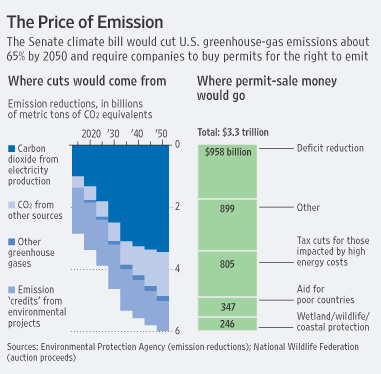
It appears that the Climate Bill is dead until next year….above is an interesting overview of the economic picture they were proposing. Here’s the short version of the vote:
Senate Republicans on Friday blocked a global warming bill that would have required major reductions in greenhouse gases, pushing debate over the world’s biggest environmental concern to next year for a new Congress and president.
Democratic leaders fell a dozen votes short of getting the 60 needed to end a Republican filibuster on the measure and bring the bill up for a vote, prompting Majority Leader Harry Reid to pull the legislation from consideration.
The Senate debate focused on bitter disagreement over the expected economic costs of putting a price on carbon dioxide, the leading greenhouse gas that comes from burning fossil fuels. Opponents said it would lead to higher energy costs.
The 48-36 vote fell short of a majority, but Democrats produced letters from six senators — including both presidential candidates Barack Obama and John McCain — saying they would have voted for the measure had they been there.
 Richard Pace