The Risk in Jarring a Complex System

The Article

I noticed this article at Andrew Revkin’s Twitter account. It makes a point, about both the environment and our global economy, that I find profoundly important to any decisions our society makes. We live in very complex environmental and economic systems. They are not understandable in any conventional logic. As a matter of fact, many aspects of the systems are illogical (thus our studies of ‘chaos’).

We have spent a lot of time in the last years attempting to find computational and logic systems in both science and economics to ‘understand’ these complex systems.

For me, placing the emphasis on understanding (and improving) the smallest elements works much better.

Environmental and Social Issues at Shareholder Meetings

Environmental and social issues were at the top of shareholders’ attention during the 2011 proxy season, according to Ernst & Young (E&Y).

About 40% of all resolutions that proceeded to a vote revolved around environmental and social issues, up from 31% last year, marking the second year in a row that these resolutions comprised the largest portion of shareholder proposals that came to a vote, according to the consultancy firm’s 2011 proxy season update.

The Article

Cargill

Through the planet’s food anxiety, Cargill has kept its name out of the public eye. There are no Cargill-branded products in supermarkets, and executives seldom speak with the press.

Yet, Cargill has a huge hand in feeding the world. With 131,000 employees, it runs one of the country’s largest operations for converting corn into biofuels, as well as food for people and animals. It’s the No. 1 U.S. salt marketer and a top buyer and seller of cocoa and sugar. The No. 2 U.S. beef producer, Cargill can slice a cow 431 ways and fashion precise cuts so Wal-Mart Stores Inc. (WMT) doesn’t have to hire a butcher for every one of its shops.

“Cargill sells seed and chemicals to farmers, buys their grain, transports it to Cargill feedlots, kills the cattle and sells the beef,” says Dan Basse, president of Chicago-based research firm AgResource Co.

“They’re not part of the food chain; they are the chain.”

The Article

2011 Corn

A number of factors combine each year to determine the U.S. average corn yield. Among those factors, temperature and precipitation during July are the most important. Crop yield models have long confirmed the large yield impact of July weather. The most favorable weather conditions in July in the heart of the corn belt consist of temperatures that are modestly below average and precipitation that is about 25 percent above average. These are the kind of conditions that were experienced in 2009 and contributed to the record high U.S. average yield that year. Historically, such conditions over large areas have been rare.

Weather conditions in July (and earlier) in 2011 have been far from ideal in many areas. Planting was late in portions of the eastern and northern corn belt. Southern portions of the U.S. have experienced hot and generally dry conditions for an extended period. The central and northern growing areas have experienced widely varying weather conditions during planting and the early part of the growing season. These widely varying conditions have been reflected in the USDA’s weekly Crop Progress reports which report crop condition ratings. As of July 10, the lowest crop ratings were reported in Texas, North Carolina, Kansas, and Ohio. The highest crop ratings were in Iowa, Kentucky, Nebraska, and Tennessee.

The continuation of high temperatures in southern areas and the expansion of hot weather to much of the corn belt this week raises additional concerns about corn yield. The high temperatures in the corn belt are occurring during the reproductive stage for a large portion of the crop. There is some indication that the intense heat will begin to moderate in many areas by the upcoming weekend. Still, average July temperatures in the corn belt may rank among the highest since 1960. In addition to the high temperatures, corn yield potential may be threatened by the expanding area of dryness over the last few weeks. For the first half of July, precipitation was well below average in large portions of Illinois and Indiana. Portions of southeastern Iowa, northwest Ohio, and eastern Michigan have also been relatively dry. Precipitation over the past 30 days was below normal in large portions of Iowa, Illinois, Indiana, Ohio, Michigan, Pennsylvania, and southern Wisconsin.

Less than favorable July weather in many areas has reduced corn yield potential in those areas. The overall impact on the likely U.S. average corn yield will be influenced by weather conditions in the last week of July and in August. Some indication of the impact will be revealed in the weekly crop condition ratings. Overall ratings for the week ended July 17 may not decline substantially, but declines could be reported for the week ending July 24 as a result of high temperatures and the lack of widespread precipitation.

The importance of the 2011 U.S. corn yield is underscored by the USDA’s projection of record consumption of U.S. corn during the 2011-12 marketing year. The most recent projection, released on July 12, forecasts consumption at 13.5 billion bushels, 195 million bushels above expected consumption during the current marketing year. Stocks at the end of the 2011-12 marketing year are projected at 870 million bushels, or 6.4 percent of projected use. Based on the forecast of 84.9 million acres to be harvested, a yield below 156.5 bushels would force a reduction in the projected level of consumption. A continuation of relatively high livestock and ethanol prices, along with growing Chinese demand, suggests that high corn prices would be required to curtail consumption.

For now, the corn market is reflecting modest concerns about the size of the 2011 crop. December 2011 futures recovered by more than $1.00 from the low on July 1, but are currently about $.50 below the high reached on June 9. Prices will continue to reflect weather conditions, weather forecasts, and crop condition ratings. As indicated last week, the nature of the 2011 planting and growing season creates a large amount of uncertainty about the size of the 2011 corn crop. Small inventories and strong demand increase the importance of crop size. As always, the USDA’s August production forecast will be highly anticipated as it will establish a benchmark for forming production expectations. That report may have added impact this year due to the possibility of adjustments to the harvested acreage forecast.

It almost goes without saying that corn prices will continue to trade in a wide range. All of the uncertainty makes it difficult to judge the overall price direction, but it appears there is more production risk than currently reflected by the corn market.

Issued by Darrel Good
Department of Agricultural and Consumer Economics
University of Illinois

Neurodiversity

From an Amazon comment on Tyler Cowen’s Create Your Own Economy:

Cowen envelops his economic points in a broader discussion of autism and its cognitive strengths, suggesting that these strengths are particularly important in this model of economy creation, and advocating for more use and acknowledgement of these strengths, particularly ordering and sequencing of specialized information, as well as a bias toward objectivity over emotionalism. Cowen also states the case that autism is not a separate condition out there from which a few suffer, but rather one point on the scale of what he calls neurodiversity, a scale on which all of us obviously must fall, some finding themselves closer to the autism point, others further.

Two Troubling Issues

In trying to develop our business plan for a Rhode Island Farmland Fund, I’ve been interrupted today by two friends….with news from other friends…that reinforce two of my biggest cultural anxieties. The first is an excerpt from John Phipps whom I consider a voice of reason in the industrial agriculture community. He is speaking about the current debate on the national debt ceiling:

I think many assume there is a script somewhere and the actors are just peaking the dramatic tension. I do not. I think we are being led by badly misinformed, power-motivated politicians who would just as soon push the economy back into recession on the gamble it would be blamed on their opponent.

Because we really don’t know how this failure would play out, there seems to be a curious sense of “Let’s find out!” floating around DC-wannabees. After all, if it goes very badly there will be plenty of mud to be splashed on everyone, and perhaps more of it will stick to the other guy. If you are currently out of power, there could be a “What do we have to lose?” mentality.

The other was an email from Peter Gengler with a link to an article on global warming driven by the thought of Bill McKibben:

Article

McKibben speaks about the need for radical action on carbon emissions.

Wealth Creation: Part Two

We met on Wednesday with two folks at the Rhode Island Foundation. They are trying to do a good job.

The Foundation is a public trust established many years ago by a local bank which now has around $600 million in assets – 60% are open, 40% are to benefit specific objectives. They appear to be trying to do a good job.

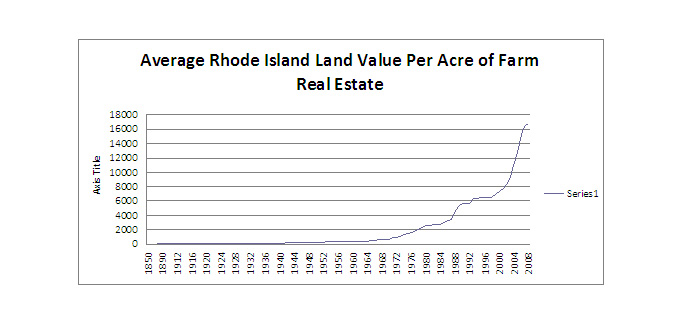
Because we are working on development of a farmland real estate fund in the State, Peter and I have been discussing our planning progress with them – thinking the venture would be of interest to them.

As part of determining how they use money (in order to better know them), I had requested a listing of their investments. I was told they usually do not disclose their investments. They did disclose that they have about $13 million in a number of program related investments (sounds like mainly loans) which evidently they manage themselves.

1) $600 million is substantial.
2) How much of their portfolio is invested in Rhode Island based enterprise?
3) Since it is a Rhode Island public trust, would it not be appropriate that all of their assets be invested in Rhode Island based enterprises?
4) Do they have sustainability and social responsibility criteria for their investment portfolio?

Obviously, they hire professional investment managers to reduce their exposure to risk while providing the best possible return. Those managers are taking a ‘whole earth’ look at the investment universe. They state that they are trying to maximize return in order to have more money each year for grants.

Obviously Number 2, their money management is consistent with most foundations, institutions of higher education, etc.

I bring this up because it is indicative of a broad set of practices that have evolved as a result of contemporary investment banking and the idea of ‘ownership’ -particularly ownership in corporate equities and the enormous number of variations that professional investors (hedge funds, etc.) have cooked up in the last twenty five years. The result is that foundations, NGOs, institutions of higher education, pension funds, and many smaller endowments are now ‘invested’ in these equities, various funds, various bonds and bond funds, etc.

Even if you look at bonds and corporate equities – perhaps the most simple to analyze – the fundamental underlying value is only one of many factors related to the value of ownership…the pschology of the market, outside ratings, etc. drive price…and therefore worth. We now have a relatively abstract ownership culture made up primarily of these kinds of institutional investors, a small group of wealthy individuals, and sovereign wealth funds. Avoiding risks now means ‘hedging’ your ownership.

I suggest a different ownership culture…where ownership is active collaboration with socially meaningful enterprises (developing criteria for ‘social meaningful’ is already going on in a number of circles). The best risk hedge, in my humble opinion, is active involvement and knowledge with enterprise development.

When I think of the total asset value of the Rhode Island Foundation, the Champlin Foundations, the Rhode Island Pension Fund, Brown University and a number of other smaller local endowments, I realize it is very substantial. They invest those monies based upon what they all believe to be the best possible use of funds. From my perspective, that ‘best possible use of funds’ has become too abstact for local needs.