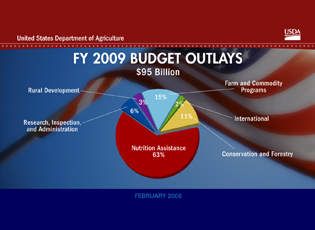
63% of the USDA budget goes to nutrition programs.
From an interview with Michael Pollan:
* At least 20 percent of all fossil fuels go to agriculture, much of that in the form of synthetic fertilizer, Pollan noted. The nitrous oxide given off by such fertilizer “is 300 times more heat-trapping than carbon dioxide,” the greenhouse gas that gets the most press.
* President Obama “has shown that he gets it,” but “there’s a long way from a leader you elect getting it and him doing anything about it.” Obama needs to realize that he’s “not going to get anywhere” on his energy or health care initiatives without addressing the problems of the food system and the American diet.
* Michelle Obama, with her organic garden at the White House and her public pronouncements on food, could potentially “change the conversation at the Good Housekeeping level.” She is “building a consensus for reform” that could be enacted “maybe in a second term.”
* Noting the influence of the food lobby on the government, he noted a recent Youtube video of a hearing on the federal School Lunch Program that was “packed with industry lobbyists.” Indeed, there were many more industry lobbyists than anyone else at the hearing.
* Farmland, particularly that near urban areas, should be considered “as precious as wetlands” if we have any hope of developing local food systems.
* Building such local systems is “not that hard to do.” One solution: legislation to compel government buyers of food (for schools, prisons, food programs, etc.) to buy locally, even if only at the margins. A 2 percent or 3 percent mandate would cause “an instant revival of local agriculture.”
* Decentralization of the food system would prevent many national or global outbreaks of food-borne diseases. When single meat-grinding operations, or single lettuce-washing operations, feed millions of people, outbreaks become global fast.
An article on HR 875 The Food Safety Modernization Act of 2009
This is an interesting post on an economic analysis done by two USDA economist on the consumption effect on fruits and vegetables given a 10% subsidy.
The author makes the following interesting statement:
Last but by no means least, I don’t think it makes a ton of sense to talk about subsidizing fruits and vegetables without talking first about un-subsidizing corn, soy and the corn ‘n soy derivatives that artificially drive down the price of Fritos and Big Macs. The policy argument for subsidizing healthy eating is convincing enough to me, but obviously is going to fly in the face of widely held anti-paternalist sensibilities. The case against subsidizing unhealthy eating, by contrast, is totally unimpeachable.
The entire post and responses:
Published on January 4th in the New York Times by Wes Jackson and Wendell Berry
The extraordinary rainstorms last June caused catastrophic soil erosion in the grain lands of Iowa, where there were gullies 200 feet wide. But even worse damage is done over the long term under normal rainfall — by the little rills and sheets of erosion on incompletely covered or denuded cropland, and by various degradations resulting from industrial procedures and technologies alien to both agriculture and nature.
Soil that is used and abused in this way is as nonrenewable as (and far more valuable than) oil. Unlike oil, it has no technological substitute — and no powerful friends in the halls of government.
Agriculture has too often involved an insupportable abuse and waste of soil, ever since the first farmers took away the soil-saving cover and roots of perennial plants. Civilizations have destroyed themselves by destroying their farmland. This irremediable loss, never enough noticed, has been made worse by the huge monocultures and continuous soil-exposure of the agriculture we now practice.
To the problem of soil loss, the industrialization of agriculture has added pollution by toxic chemicals, now universally present in our farmlands and streams. Some of this toxicity is associated with the widely acclaimed method of minimum tillage. We should not poison our soils to save them.
Industrial agricultural has made our food supply entirely dependent on fossil fuels and, by substituting technological “solutions” for human work and care, has virtually destroyed the cultures of husbandry (imperfect as they may have been) once indigenous to family farms and farming neighborhoods.
Clearly, our present ways of agriculture are not sustainable, and so our food supply is not sustainable. We must restore ecological health to our agricultural landscapes, as well as economic and cultural stability to our rural communities.
For 50 or 60 years, we have let ourselves believe that as long as we have money we will have food. That is a mistake. If we continue our offenses against the land and the labor by which we are fed, the food supply will decline, and we will have a problem far more complex than the failure of our paper economy. The government will bring forth no food by providing hundreds of billons of dollars to the agribusiness corporations.
Any restorations will require, above all else, a substantial increase in the acreages of perennial plants. The most immediately practicable way of doing this is to go back to crop rotations that include hay, pasture and grazing animals.
But a more radical response is necessary if we are to keep eating and preserve our land at the same time. In fact, research in Canada, Australia, China and the United States over the last 30 years suggests that perennialization of the major grain crops like wheat, rice, sorghum and sunflowers can be developed in the foreseeable future. By increasing the use of mixtures of grain-bearing perennials, we can better protect the soil and substantially reduce greenhouse gases, fossil-fuel use and toxic pollution.
Carbon sequestration would increase, and the husbandry of water and soil nutrients would become much more efficient. And with an increase in the use of perennial plants and grazing animals would come more employment opportunities in agriculture — provided, of course, that farmers would be paid justly for their work and their goods.
Thoughtful farmers and consumers everywhere are already making many necessary changes in the production and marketing of food. But we also need a national agricultural policy that is based upon ecological principles. We need a 50-year farm bill that addresses forthrightly the problems of soil loss and degradation, toxic pollution, fossil-fuel dependency and the destruction of rural communities.
This is a political issue, certainly, but it far transcends the farm politics we are used to. It is an issue as close to every one of us as our own stomachs.
Wes Jackson is a plant geneticist and president of The Land Institute in Salina, Kan. Wendell Berry is a farmer and writer in Port Royal, Ky.
In their recent policy primer for the Mercatus Center at George University economic geographer Pierre Desrochers and economic consultant Hiroko Shimizu challenge the notion that food miles are a good sustainability indicator.
An interesting review of a new movie about eating locally produced, healthy fresh food.
The reviewer points out the shortcoming of using lots of ‘elite’ chefs to sing the virtues of fresh food when the real issues are not the value of fresh, organic foods, but how to have it available (and reasonably priced) in the neighborhoods that now see only canned and processed products on their grocery shelves.
http://www.treehugger.com/files/2008/11/movie-review-food-fight.php
I just read John Phipps most recent blog about farm finances, fertilizer prices, etc. (http://johnwphipps.blogspot.com/) and realized it sounds a lot like someone trying to explain our recent banking industry. John’s a smart guy who I respect…so I’m worried.
First, it was confusing….lots of stuff that sounded like speculation and manipulation. Second, it was complicated….not complex or intelligently sophisticated, just complicated. Third, it was about repeatedly growing the same crop on the same land….and all the ‘inputs’ necessary to reuse the soil every year for the same crop or a very similar rotation crop.
The grain farming community is worried…and dependent on all those costly inputs.

