
An interesting opportunity (now that investment portfolios have recovered some…and investors might find tax credits attractive) from a colleague in Washington.
Category: Food
Sometimes we can’t get out of our own way
Absolute idiocy
Health Department Raids Community Picnic and Destroys All Food with Bleach
Rural Farming Lessons from China
China’s industrial growth has challenged the economic might of the United States, but the country’s advances have not occurred evenly. They have come at the expense of rural development, particularly in regions characterized by unfavorable natural conditions and fragile ecosystems. Although China has attained a high degree of grain sufficiency (about 95 percent) and remains a net food exporter, there are signs of enduring serious problems. Poverty combined with food insecurity and malnutrition continues to affect around 150 million Chinese people, according to recent estimates based on the World Bank poverty line of U.S.$1.25. This has exacerbated the widening gap between the wealthy coastal areas, supported by industrial development, and the impoverished peasants of the northwest and southwest who rely on subsistence production. In addition, agricultural income is generally declining and represents a lower percentage of rural household income; many farmers are losing interest in farming, with women and older people becoming the main agricultural cultivators.
Participatory research conducted in southwest China has resulted in concrete strategies to deal with these challenges. Farmers, led by women, have organized effective local organizations for technology development, seed management, and market linkages, with innovative support from the staff of public research and extension agencies. Collaborative field experiments to improve crop varieties—an approach known as participatory plant breeding—local biodiversity fairs, organic farming practices, new market channels, and new forms of research and policy support are contributing to improved farmer livelihoods and to a more dynamic and equitable process of rural development. Modernizing rural development using traditional and local knowledge stands in stark contrast to the shift to industrialized agriculture in China’s coastal regions. Both approaches will be needed if China is to address the challenges of food security, well-being, sustainable natural resource management, and biodiversity conservation.
The Article
The Local Food Economy in 2 Charts

A very dramatic chart on the age demographics of farmers.
For both charts and this important Article
Food for 9 Billion
An interesting series on feeding the world.
The Link
Organic Tomatoes in the Winter
The explosive growth in the commercial cultivation of organic tomatoes here (Mexico), for example, is putting stress on the water table. In some areas, wells have run dry this year, meaning that small subsistence farmers cannot grow crops. And the organic tomatoes end up in an energy-intensive global distribution chain that takes them as far as New York and Dubai, United Arab Emirates, producing significant emissions that contribute to global warming.
From now until spring, farms from Mexico to Chile to Argentina that grow organic food for the United States market are enjoying their busiest season.
The Article
The Last Waterman of Wittman
McRib is Back
McDonald’s has renewed the McRib…a concoction actually composed much like sausage then ‘cut’ to shape. It has been much maligned by many.
Here is an interesting graph of the periods in which the McRib has been ‘re-introduced’.
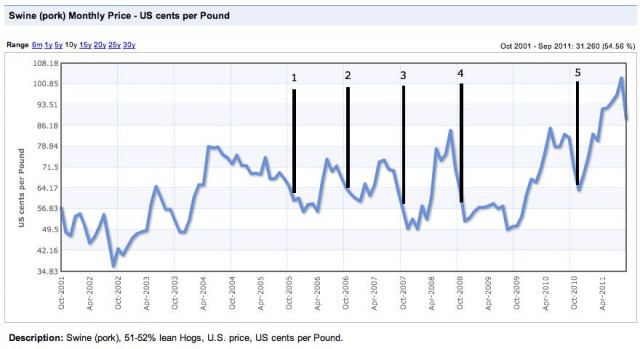
Interesting coincidence between pork prices and McRib….their business planners at work.
Cargill
Through the planet’s food anxiety, Cargill has kept its name out of the public eye. There are no Cargill-branded products in supermarkets, and executives seldom speak with the press.
Yet, Cargill has a huge hand in feeding the world. With 131,000 employees, it runs one of the country’s largest operations for converting corn into biofuels, as well as food for people and animals. It’s the No. 1 U.S. salt marketer and a top buyer and seller of cocoa and sugar. The No. 2 U.S. beef producer, Cargill can slice a cow 431 ways and fashion precise cuts so Wal-Mart Stores Inc. (WMT) doesn’t have to hire a butcher for every one of its shops.
“Cargill sells seed and chemicals to farmers, buys their grain, transports it to Cargill feedlots, kills the cattle and sells the beef,” says Dan Basse, president of Chicago-based research firm AgResource Co.
“They’re not part of the food chain; they are the chain.”
Food Stamps as National Security
Let’s run the numbers. One in seven households in America receives food stamps, and one in six would qualify. Nearly 1/2 of all American children live in households that receive food stamps. One in eight food stamp households cares for an elder, one in five cares for a disabled non-elderly adult. One out of every five recipient households has *no* other countable income – more than 7 million Americans total.
Cancel food stamps and 7 million Americans drop to zero income. More than 2/3 of those households include children. The average food stamp recipient household owns $101 of goods and savings – total.
The Article
 Richard Pace