A very thought provoking chart on Federal energy subsidies…along with an article pointing out some of the paradoxes in the subsidy amounts.
http://www.treehugger.com/files/2008/09/energy-subsidies-support-2007.php
A very thought provoking chart on Federal energy subsidies…along with an article pointing out some of the paradoxes in the subsidy amounts.
http://www.treehugger.com/files/2008/09/energy-subsidies-support-2007.php
Though details are somewhat sketchy, Cleantech reports that Deepwater Wind has been selected to develop Rhode Island’s first offshore wind project. Expected to cost over $1 billion and supply 15% of the electricity requirements of the state (1.3 million megawatt-hours), no time scales has been presented for the project.
In addition to the wind project, Deepwater has pledged to invest $1.5 billion to develop a regional manufacturing facility in Rhode Island, creating 800 green tech jobs in the process.
EPA today released the “2008 Report on the Environment: Highlights of National Trends” (2008 ROE HD), which provides the American people with an important resource for better understanding trends in our nation’s health and environment. The report is intended for a general audience and summarizes highlights of the more comprehensive “EPA’s 2008 Report on the Environment,” which was released in May, and provided the scientific and technical information. Together the two reports present national environmental trends and inform EPA’s strategic planning process with the best available, scientifically sound information.
EPA also launched a new Web site that allows the user to search the full technical report for specific trends in air, water, and land.
The 2008 ROE HD, ROE and searchable eROE: http://www.epa.gov/roe

From an article by Matthew McDermott:
Expanding and improving the United States’ electrical transmission grid would be a major building block in creating an electrical supply that is reliable, efficient and clean. The move to make that happen got a new ally today: Google. The internet giant has announced that it will be partnering with GE to work on both the technological side of the problem as well as the policy angle. This is the plan:
Tech: Geothermal + Plug-In Vehicles
Initially the technological focus will be on developing utility-scale renewable energy—which for Google means enhanced geothermal systems (at least to start)—and software, controls and services to allow utilities to integrate plug-in vehicles into the grid.
Policy: More Capacity + Smart Grid
Two initial policy challenges will be tackled. 1) Expanding the capacity of the transmission grid so that renewable energy can be brought from the places where it is most easily generated to where it is most needed—the existing grid isn’t optimal for this. 2) Development of a smart grid, which will allow electricity users to better manage their electric usage and ultimately consume less electricity through better efficiency.
John Phipps posted this interesting graph.

In 1969, GM introduced a hybrid car.
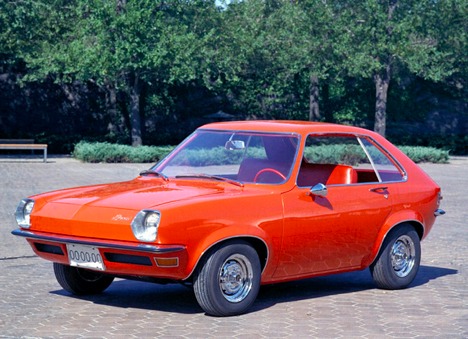
Chuck Squatriglia in Wired describes it: “The heart of the car was a 35 cubic inch (573 cc) two-cylinder engine — small enough to be exempt from the emissions rules of the day — coupled with a DC motor powered by six lead-acid batteries just like the one under your hood. You could tool around in all-electric mode or in gas-electric mode, according to PopSci. In hybrid mode, the electric motor did all the work to about 10 mph, at which point the gasoline engine took over. If you needed to really get up and go, the engine and motor worked in tandem. Still, the car was as slow as it was advanced. Top speed was just 60 mph, and it needed 28 seconds to get there — making it only slightly faster than a Citroen 2CV6.”
In 1969 I was in my last year of engineering school and GM was introducing the first SUV…the Chevy Blazer.
No it’s not a typographic error…
The Future Renewable Electric Energy Delivery and Management (FREEDM) Systems Center, headquartered on NC State University’s Centennial Campus, is one of the latest Gen-III Engineering Research Centers (ERC) established by National Science Foundation in 2008. The FREEDM Systems Center will partner with universities, industry and national laboratories in 28 states and nine countries to develop technology to revolutionize the nation’s power grid and speed renewable electric-energy technologies into every home and business. The center is supported by an initial five-year, $18.5 million grant from NSF with an additional $10 million in institutional support and industry membership fees. More than 65 utility companies, electrical equipment manufacturers, alternative energy start-ups and other established and emerging firms are part of this global partnership.
From an article by the Rocky Mountain Institute:
Though less fierce than expected, Hurricane Gustav highlighted once again the vulnerabilities presented by our centralized energy systems.
Within the Gulf of Mexico, 98 percent of the oil and natural gas production facilities were shut down ahead of the storm. More than 10 refineries were also closed, while numerous others were running at a reduced rate. Combined, this halted at least 18 percent of the U.S. capacity to turn crude oil into gasoline and other petroleum products.
The storm passed directly over the Louisiana Offshore Oil Port, a facility that unloads tankers and accounts for 10 percent of U.S. oil imports. Transmission lines gave way to the wind and knocked 35 substations out of service, leaving more than one million customers without power.
Back in 1982, Amory Lovins — Chief Scientist and founder of Rocky Mountain Institute — warned the U.S. Department of Defense that a handful of people could cut off three-quarters of the Eastern states’ oil and gas supplies in one evening without leaving Louisiana.
Had we heeded and acted on Lovins’ warning and subsequent advice, Hurricanes Katrina and Gustav may not have presented such challenges for our energy infrastructure and security.
According to Lovins, true security measures — led by energy efficiency and distributed, renewable resources — can make us feel safe in ways that work better and cost less.
What does a secure energy system look like?
To begin with, it is geographically dispersed, comprised of redundant smaller modules that can back each other up, is located close to end-users to minimize transmission lengths, and is heavily interconnected so that if one part fails, other components continue to work seamlessly.
As Lovins indicated to the U.S. Senate in 2006, both energy independence and its purpose, energy security, rest on three pillars:
1. Making domestic energy infrastructure, notably electric and gas grids, resilient through efficiency, diversity, and distributed systems.
2. Phasing out, not expanding, vulnerable facilities and unreliable fuel sources.
3. Ultimately eliminating reliance on oil from any source.
 Richard Pace